AOI · The evidence
The evidence
AOI is an integrated multisensory environment. We are transparent about what is established, what is emerging, and what we measure directly.
This page holds all of it — what we have observed in our own tracking, why the design might work, and what the wider research does and does not support. Where the research hedges, the hedge stays.
How we grade it
Three levels of evidence.
Established science
Well-researched fields that AOI draws on — photobiomodulation, auditory stimulation, multisensory integration. Strong as fields in their own right, but research on a component is not research on AOI.
Emerging science
Promising and moving quickly, but not settled: 40 Hz gamma stimulation, and specific frequency-based effects. Real signal, still experimental for therapeutic use.
AOI-specific evidence
What we measure ourselves, in real-world use — wearable data and live blood imaging. This is the level that matters most, and the level where the evidence base is youngest.
Why it works
Three reasons the design holds up.
Multisensory integration
Why light and sound together
The brain responds more to synchronised light and sound than to either one alone. That is the central idea behind AOI: not that any single colour or tone is extraordinary, but that they arrive together, in one room, for the length of a session. It is a rationale for the design rather than a proven outcome — and it is why the honest thing to study is the whole session.
The session is the unit, not the wavelength.
Photobiomodulation
An established research field
Red and near-infrared light supports cellular energy and recovery. It is a genuinely established field for localised use; whole-body research is newer, and a 2025 systematic review called it promising but in need of stronger, more standardised clinical evidence.
40 Hz gamma stimulation
The best-evidenced frequency in AOI
Synchronised 40 Hz light and sound, studied at MIT for attention, memory and neural synchrony. Human studies show measurable neural entrainment; a 2026 review found responses depend heavily on the person and the stimulus. Promising and developing quickly — still experimental for therapeutic use.
None of this is evidence for AOI itself.
These are the fields AOI is built on. Research on a component does not transfer to the complete system, and we do not present it as though it does — which is why the rest of this page is about what we have actually measured.
AOI-specific · what we measured
Observed in our WHOOP tracking.
Recovery rose
Recovery scores climbed over consecutive sessions rather than after any single one. The change was cumulative — no session produced the jump on its own.
HRV increased
Heart-rate variability rose. HRV is widely used as an indirect indicator of how adaptable the nervous system is, and how much recovery capacity is available.
Resting heart rate trended lower
A move towards a lower or steadier resting heart rate — read alongside the other metrics, never on its own.
Sleep improved
Better sleep quality and duration: higher efficiency and less overnight physiological stress, more often than simply more hours.
A shift towards recovery
Taken together, the pattern is consistent with a parasympathetic, recovery-oriented state — the same stressors arriving without the same escalation.
AOI internal observation · ongoing
What the wearable data showed.
Participants wore their own WHOOP devices through structured AOI programs and shared the data. Every participant so far has shown either measurable improvement or stable physiology across the findings above.
It has not been uniform, and we publish that too. One participant's first two sessions produced nothing at all. Another ran two blocks of sessions: the first produced the clearest autonomic change we have recorded, and the second fell below their own pre-AOI baseline — in a window their own prior data marks as their lowest-recovery phase, carrying higher training strain, more fragmented sleep and continuing sleep debt.
These are AOI's own internal observations, recorded in real-world conditions and published anonymously with consent — not an independent or controlled study. Observation of this kind does not establish causality, and the programme is still running: standardised, controlled AOI research is ongoing.
AOI-specific · beyond wearables
Live blood analysis.
Live blood darkfield microscopy of the same client, filmed before and after a single AOI EARTH session. Both frames are the same optics, exposure-normalised for display.
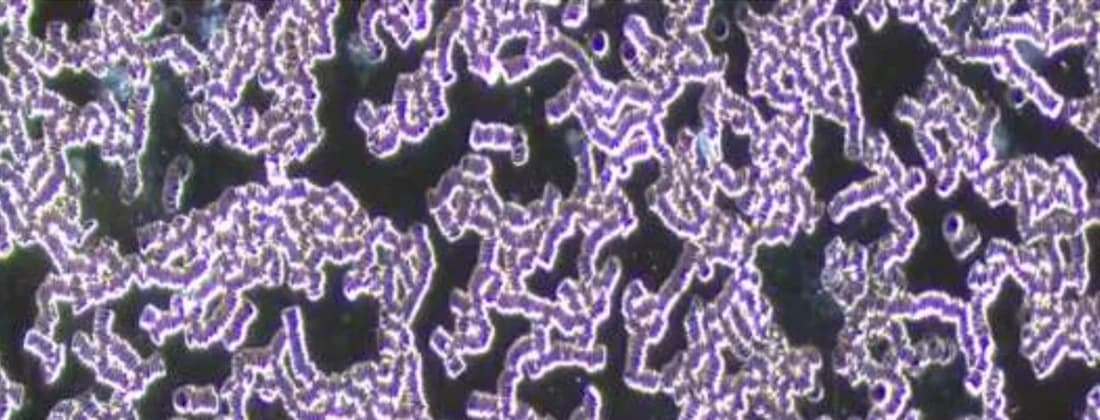
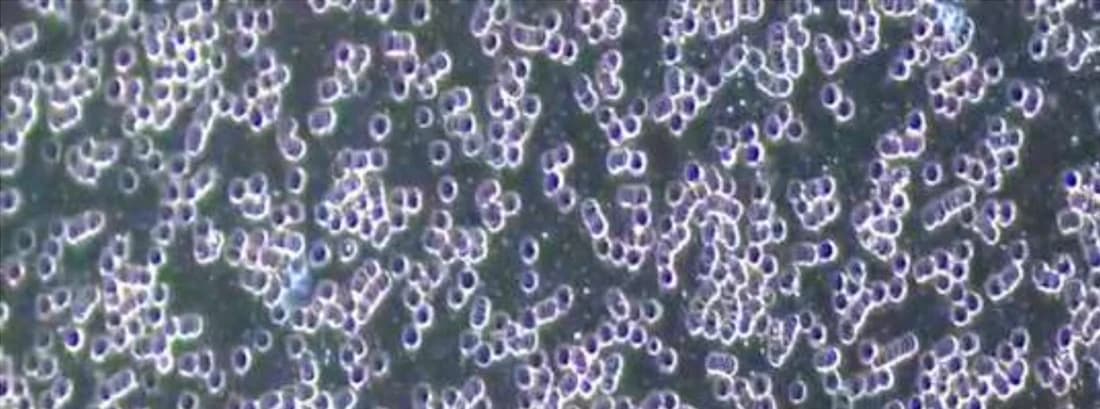
Aggregation cleared
The baseline shows red cells stacked edge-to-edge in long rouleau chains. Afterwards they appear separated and evenly dispersed.
Mobility restored
Discrete cells drift independently through open plasma rather than moving as fused clumps, presenting more free surface than stacked cells.
How to read this.
One client, one session, no control and no repeat. Rouleaux formation is also known to be sensitive to how a sample is handled — time on the slide, temperature and preparation all affect it — so a difference between two frames is not on its own evidence of a change in the person. Darkfield live blood analysis is not an accepted diagnostic method and nothing here diagnoses anything. Like the wearable data, this is an observation worth investigating, not a demonstrated effect.
How often
What AOI reports, and what that is worth.
AOI reports this pattern occurring in 100% of sessions tested to date. That is an internal AOI observation, not yet the subject of an independent, controlled study.
Rouleaux formation is also known to be sensitive to how a sample is handled — time on the slide, temperature and preparation all affect it — so a difference between two frames is not on its own evidence of a physiological change.
The fields we draw on
What the wider research says.
Photobiomodulation
Red and near-infrared light, studied in relation to cellular function, tissue recovery, inflammation and exercise recovery. Strong as a field; thinner for whole-body use, and not direct evidence for AOI.
40 Hz gamma stimulation
Rhythmic light and sound at around 40 Hz can produce measurable neural entrainment in humans. Responses vary significantly by person and stimulus. Promising, still experimental.
Auditory stimulation and music
Music interventions can reduce psychological stress and shift stress-related physiology. Effects on the psychological state are established; physiological and frequency-specific effects remain mixed.
Blue and visible light
Extensively studied in dermatology, and human skin does contain light-sensitive proteins called opsins. But findings for one wavelength cannot be generalised to every colour in a program.
Specific sound frequencies
Individual frequencies such as 432 Hz and 528 Hz appear in small studies of relaxation and wellbeing. The evidence is thin next to established fields, so we treat them as open questions, not settled fact.
Frequency by frequency
The evidence varies a lot by frequency.
The strongest
The best evidence-supported frequency in AOI. MIT research shows synchronised 40 Hz light and sound may influence gamma oscillations linked to attention, memory and neural synchrony. Animal studies showed reductions in Alzheimer's pathology; early human trials suggest safety and possible cognitive benefit. Still an active research area.
Preliminary
The best studied of the Solfeggio frequencies. Small studies have reported reduced cortisol, increased oxytocin and improved autonomic balance. The evidence is preliminary and not enough to establish clinical benefit.
Limited
Many listeners find it more pleasant than standard 440 Hz tuning, and small studies suggest reduced heart rate and anxiety. Not enough to conclude it has unique biological effects beyond preference.
The vibration, not the number
Low-frequency vibration can contribute to vibroacoustic stimulation, and research suggests it can influence relaxation, muscle tension and pain perception. The benefit appears to come from the vibration itself — nothing singles out 150 Hz.
No robust evidence
Popular in sound-healing traditions and used in meditation and relaxation practice. There is currently no robust clinical evidence of physiological effects unique to any of these individual frequencies, and we do not claim any.
How to read all of this
Open to possibilities, without presenting possibilities as facts.
Everything on this page is either published research on the fields AOI draws on, or observations from real-world AOI use. Neither is a clinical trial. Observational data shows association, never causation: sleep, training load, illness, travel and daily stress all moved while these measurements were taken, and cannot be separated out.
Some mechanisms behind AOI have substantial independent literature. Others are emerging. Some of Johny Dar's observations remain hypotheses that require direct testing. We do not consider that a limitation — it is where the research starts.
AOI is not a medical device and is not intended to diagnose, treat, cure, mitigate or prevent any disease. CE certification is ongoing.
EXPERIENCE
Read it, then feel it.
The evidence is one half. The session is the other — a private room, light and sound, and nothing asked of you.