AOI · Reoccupy Your Body
Reoccupy Your Body Training
Most training asks how the body can become stronger, faster or more flexible. Reoccupy Your Body asks a prior question: what is stopping the body from moving freely in the first place? It is Johny Dar's own movement practice, developed over years of observation, and the physical expression of the Art of Implosion — building the body from the inside out rather than the outside in.
A session moves through seven stages — tapping, awareness, geometry, twisting, the three layers of habit, breath and holds, integration — so that what restricts movement is worked on before strength, mobility and posture are rebuilt on top of it. Nothing is forced. The measure of a session is not exhaustion but the difference between the state you arrive in and the state you leave in.
The training runs as a community experience at the AOI flagship in Dubai and is open to people who have completed at least ten AOI sessions. It is Johny Dar's own work and personal observation, a conceptual framework rather than established scientific consensus, and it is not a treatment for any condition.
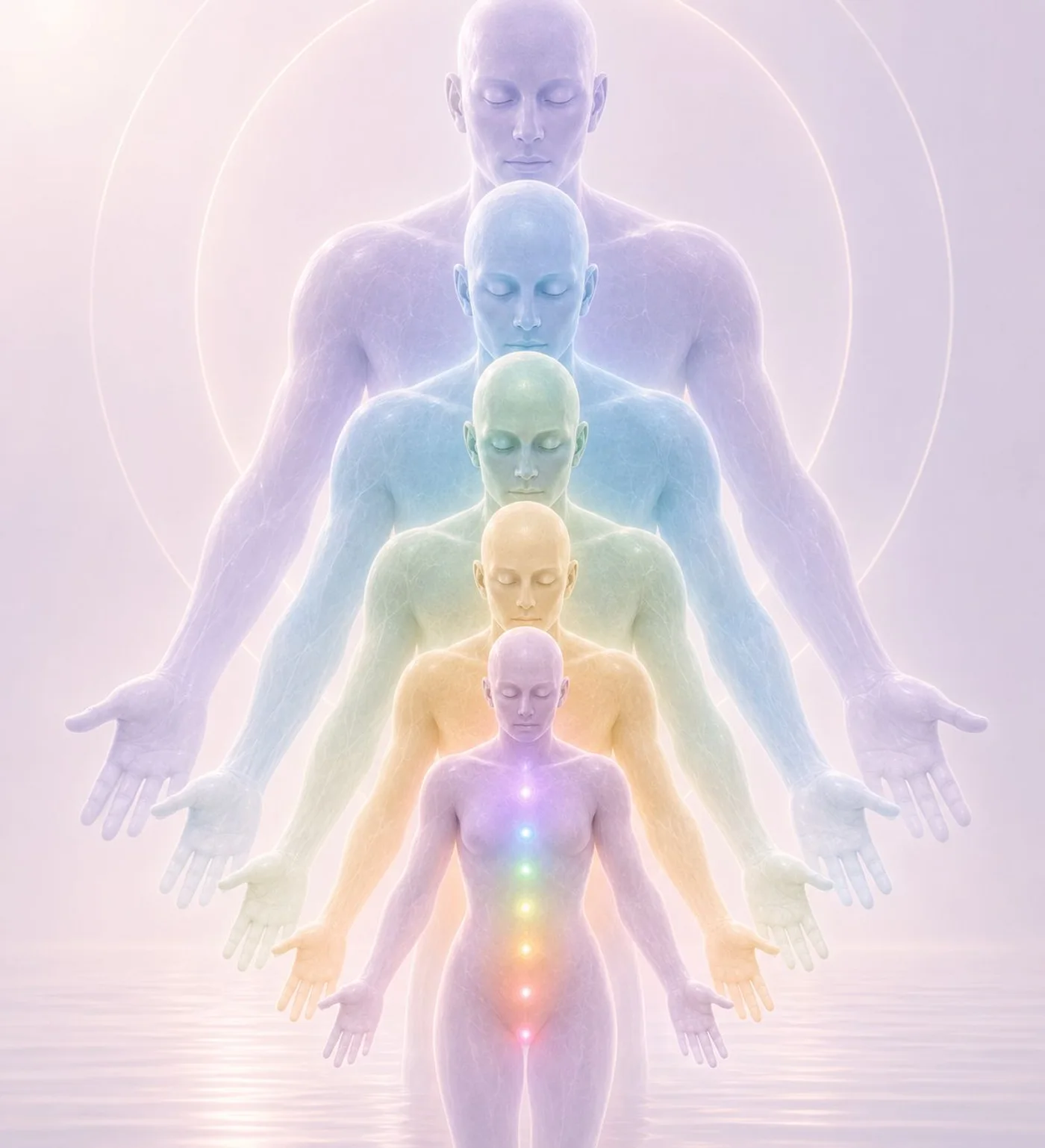
Two directions
Explosion adds force. Implosion creates space.
The Art of Explosion — outside in
Conventional training asks the body to exceed what it can do today: more load, a deeper stretch, repetition to fatigue, then recovery. If a restriction or a compensation is already there, the body may simply become stronger around the pattern it already knows.
The Art of Implosion — inside out
Reoccupy Your Body asks what is holding a movement back and works on that first — through breath, geometry, twisting and held positions — so there is room for the joint to move and the spine to reorganise before strength is built on top of it.
One continuous process
The seven stages of a session.
Each stage sets up the next, so a session is a single unfolding sequence rather than a list of exercises.
01
Tapping
A patterned tapping sequence introduces the first ripple. The contact is local; because the body is one connected system, the response is not.
02
Awareness
Noticing sensation, tension, resistance, emotion or thought without immediately pushing it away — the move from automatic reaction to observed experience.
03
Geometry
The body moves into the triangle, the square and the circle, the three forms that organise the whole practice.
04
Twisting
Controlled spiral and rotational movement works through restriction and begins connecting the body along its chains, from the feet to the hands — what the method calls the coil.
05
Three layers
Specific positions address habit at the conscious, subconscious and unconscious level, so that patterns which ran automatically become observable.
06
Breath and holds
Breath and sustained positions keep working with a restriction rather than forcing the body past it, changing internal pressure and state.
07
Integration
Fascia, joints, spine and the muscular chains are brought together as one system, and the pattern learned in the room begins to carry into ordinary movement.
Tapping initiates. Awareness reveals. Geometry organises. Twisting mobilises. Breath creates space. Movement integrates.
Geometry of perception
Triangle, square, circle.
Within the AOI framework each form corresponds to one of the senses through which the body reads its surroundings, and to the shape of the skull around that sense.
Triangle · Smell
The nose, and the triangular structures of the nasal area of the skull.
Square · Sight
The eyes, and the orbital structures that frame them.
Circle · Hearing
The ears, and the openings on either side of the skull.
Habits of perception can show up physically — as guarded posture, restricted movement, tension around the joints. Holding the geometric positions while the body moves through controlled twists is how the practice begins to loosen that link, so that what is seen, heard and smelled is received without reproducing the same physical pattern.
Training as inner work
Do not build strength around the armour.
A person can become considerably stronger while keeping every habitual tension and very little sense of what is happening inside. Adding force around a pattern that has never been looked at is, in AOI's language, building armour around it: the body gets stronger, and the pattern stays. The practice asks whether the reason for the armour can be understood before the armour is reinforced.
The aim is not less strength. It is a body that is strong and sensitive at the same time — stable and adaptable, defined and responsive — because the method depends on being able to notice small changes in sensation, breath and internal state.
A difficult position reveals more than a stiff hip. It can surface impatience, control, fear, self-doubt, the need to succeed or the inability to let go. The movement becomes a mirror, and the pattern can be observed as it happens rather than trained a little deeper into the body.
Possible experiences, not promised outcomes
What people notice.
The most consistent report is a change of state inside the session — arriving heavy, foggy or low on energy, and leaving lighter, clearer and more awake. Along the way, people describe:
Waves of energy
Energy moving through the body, warmth, tingling or goosebumps.
Spontaneous movement
Shaking, trembling, or a movement the body seems to want to finish on its own.
Release
A sense of lightness, of something letting go, or of more room to move.
Emotional openness
Emotion surfacing, spontaneous laughter, or a softening that was not planned.
Clarity
A clearer, quieter mind by the end of the session.
Heightened sensation
A more precise sense of where the body is and how it is holding itself.
None of these is the goal, and none is required for the practice to work. They are examples of what participants report as their internal state changes; experiences vary, and some people notice very little.
After the session
The workout ends. The integration continues.
People who practise consistently report noticeably less of the soreness and stiffness they associate with conventional gym work, because nothing in a session forces the body past its limits. In the hours and days after, some notice spontaneous changes in how they stand, walk, stretch, rest or sleep — as if the body were still replaying elements of the practice on its own.
A break from regular practice can bring a stiffness of its own. Within the AOI framework this is read not as damage from a session but as reorganisation that is still under way: the body wants to continue a movement, a twist or a release that the session began.
Why a community
The group is part of the method.
Practising alone, you respond to your own body, breath and state. In a group, every person becomes part of the room everyone else is reading — the sound of others breathing, their rhythm, the shifts in mood around you. Attention widens from muscle to body to emotion to the room, and the practice becomes shared regulation as well as self-regulation. This is why the training is taught as a community experience.
The group is also a mirror. Someone else's openness, confidence or release can bring up irritation, vulnerability, comparison or the sight of your own self-control. None of that is separated from the physical work; it is allowed to surface inside it.
How it compares
Not a substitute for training. The foundation under it.
Reoccupy Your Body
Starts with what is preventing free movement. Builds from the inside out: space first, then strength. Treats the body as one connected system from the toes to the fingertips, works on the inner patterns inside the exercise, and is designed to leave you more activated than you arrived.
Conventional gym training
Starts with how to add load or muscle. Builds from the outside in: force, then adaptation. Muscles are largely trained as separate groups, the pattern behind a restriction is often reinforced rather than resolved, and the inner work, if any, happens elsewhere.
Conventional stretching
Starts with how far a position can be extended. Force is applied to the tissue, which can override a restriction rather than release it. Range increases for a while; the structure underneath is left as it was.
AOI positions the training as what comes before conventional exercise: the practice that creates the conditions from which strength, mobility and posture are rebuilt with less resistance from the body's own compensations.

“Don't force the body to become something new. Remove what unnecessarily restricts it, create space, and allow strength, movement and posture to be rebuilt from the whole.”
Apply to participate
The next training, in Dubai.
Reoccupy Your Body runs as a community experience at the AOI flagship in Dubai, in small groups. To take part you need to have completed at least ten AOI sessions, so that the body already knows the environment the training builds on. Leave your details below. We review every application, and if your participation qualifies we send you the full information and the terms.
We use these details to review your application and reply, and for nothing else. See our privacy policy.